Don't you have an account?
Register nowLogin your account
No problem!
Already have an account?
Login nowCreate an account
Home / General Science / New Horizons Journal of Basic and Applied Sciences
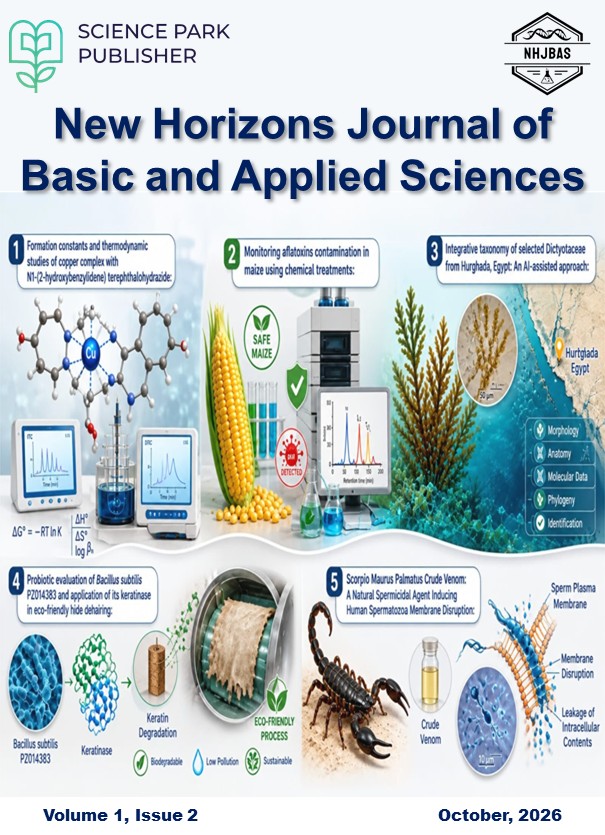
Volume 1, Issue 2, October 2026 Pages 77-143
Dr. Hesham MH Zakaly
Editor-in-Chief of New Horizons Journal of Basic and Applied Sciences
We are pleased to present Volume 1, Issue 2 of New Horizons Journal of Basic and Applied Sciences. This issue spans coordination chemistry, food safety, marine taxonomy, microbial biotechnology, and reproductive pharmacology.
Our first study examines copper (II) complexation with a novel Schiff base ligand, revealing stepwise stability constants that decrease with temperature and confirming an enthalpy-driven, exothermic process: the first ligand binds most strongly, while successive additions face steric and electrostatic penalties. Turning to aflatoxin contamination in maize, a comprehensive review shows that antioxidants, phenolic acids, and ozone can suppress Aspergillus flavus growth and toxin biosynthesis by alleviating oxidative stress, though sub-inhibitory BHT may paradoxically stimulate toxin production, urging precise dosing.
In marine taxonomy, an AI-assisted approach combines classical morphology with ResNet50 deep feature extraction to classify eight Dictyotaceae species from the Red Sea. Neural network clustering (silhouette score 0.70) largely mirrored traditional morphological groupings, showing deep learning as a complementary tool for species identification. A probiotic Bacillus subtilis strain PZ014383 survives simulated gastric stress, exhibits selective antimicrobial activity, and produces a keratinase that effectively dehairs buffalo hide without collagen damage—offering a greener alternative to lime-sulfide treatment. Finally, crude venom from the scorpion Scorpio maurus palmatus immobilized 100% of human spermatozoa within 20 seconds via irreversible membrane disruption. Proteinase K abolished activity while heat treatment did not, identifying a heat-stable proteinaceous factor with promise for non-hormonal contraception.
We invite readers to engage with these findings—to replicate, challenge, and build upon them.
Research Article - Published In Issue Oct. 30, 2026
View PDFResearch Article - Published In Issue Oct. 30, 2026
View PDF
 Download full issue