Don't you have an account?
Register nowLogin your account
No problem!
Already have an account?
Login nowCreate an account
Home / Materials Science / Multidisciplinary Materials Chronicles
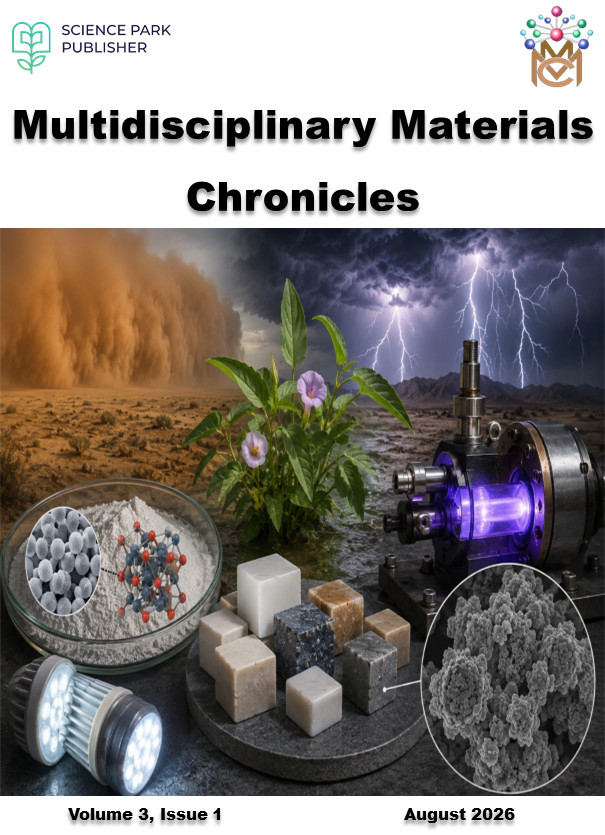
Volume 3, Issue 1, August 2026 Pages 112-176
Editor-in-Chief of Multidisciplinary Materials Chronicles
We are
delighted to open Volume 3, Issue 1 of Multidisciplinary Materials
Chronicles with a collection of research that spans from fundamental
plasma physics to the environmental consequences of nanomaterials. If one takes
a moment to look at our cover for this issue, its visual composition tells the
exact story of our printed pages—it encapsulates an interconnected journey from
microscopic plasma interactions to the macro-environmental conditions shaping
our air quality and plant life.
At the
forefront of materials characterization, we include a detailed investigation
into plasma dynamics within a DC Ar-N2 hollow cathode discharge system . By
leveraging optical emission spectroscopy, the authors provide granular insights
into surface interactions, offering critical knowledge for tailoring
plasma-based material surface modifications. Equally compelling from a
structural materials standpoint is the study on lanthanum-doped lead titanate
perovskite ceramics. This work systematically dissects how grain size
manipulation dictates the resulting dielectric properties—a foundational piece
of knowledge necessary for advancing next-generation electronic components.
Transitioning
from solid-state physics to biological and environmental interfaces, our issue
presents a crucial comparative study on Ipomoea aquatica . By
exposing this aquatic plant to zinc sulfate, zinc oxide, and zinc oxide
nanoparticles, the authors unravel the complex metabolic responses and uptake
mechanisms. Such findings are vital as we grapple with the ever-growing
footprint of engineered nanomaterials in natural ecosystems. This environmental
thread is beautifully echoed in the spatial-temporal assessment of thunderstorm
frequency over Iraq . By linking atmospheric meteorological events directly to
PM2.5 concentrations, this research demonstrates how macroscopic atmospheric
dynamics ultimately dictate the quality of the particulate matter we are exposed
to.
Rounding
out this multidisciplinary mosaic, we turn to the practical reliability of
everyday materials with a study on the aging performance of LED lamps.
Understanding material degradation over time is not just an engineering
exercise; it is an economic and sustainability imperative. We hope this issue
serves as a testament to the power of interdisciplinary science—demonstrating
that whether we are examining the glow of a plasma discharge or the resilience
of a plant exposed to zinc nanoparticles, the material world is profoundly
interconnected.
We
extend our gratitude to the authors, reviewers, and editorial team who made
this vibrant issue possible. We look forward to the continued dialogue and
contributions that define our journal's commitment to materials science across
all disciplines.
Research Article - Published In Issue Aug. 20, 2026
View PDFResearch Article - Published In Issue Aug. 20, 2026
View PDFResearch Article - Published In Issue Aug. 20, 2026
View PDF
 Download full issue